Warehouse Detailed Flooring Guide: Epoxy, Polished Concrete, Urethane Cement
Your warehouse floor carries every pallet, forklift, and rack in the building. When it starts to fail, productivity, safety, and maintenance budgets all suffer. In Philadelphia warehouses and distribution centers, choosing the right flooring system means balancing heavy loads, moisture, freeze–thaw conditions, and chemical exposure. This guide explains how different warehouse flooring solutions perform in real conditions and how to select a system that will support your facility for years, not just the first few seasons.
Why the Right Industrial Floor Is Critical for a Warehouse
Most warehouses sit on a standard concrete slab, but bare concrete is not designed for constant real‑world use. Under forklifts, pallet jacks, and heavy racks, the surface starts to dust, abrade, crack, and break down first in turning zones, aisles, and under concentrated rack posts.
In daily operation the floor sees far more than static weight. Forklifts generate impact and dynamic loading, racks apply continuous point pressure, and traffic follows the same paths hour after hour. This creates deep wear tracks, rough joints, and uneven surfaces that slow equipment and increase maintenance.
When oils, fuel, and other chemicals are present, untreated concrete absorbs liquids, loses strength, and becomes harder to clean. If moisture is trapped in the slab or not tested before installation, even a good coating can blister, delaminate, or fail prematurely.
Once the flooring system no longer matches actual warehouse conditions, risk rises quickly: workers face trip and slip hazards, equipment runs rougher, and repair costs and downtime go up.
A properly engineered warehouse floor should:
- Withstand calculated loads without surface deformation.
- Provide abrasion and impact resistance in traffic and turning zones.
- Protect the slab from chemical attack and moisture.
- Maintain flatness and traction in high‑traffic areas.
- Make cleaning and dust control manageable across large floor areas.
Where Concrete Floor Deterioration Begins
A typical slab is engineered for structural strength, not for years of constant traffic, turning forklifts, and heavy rack posts. In real warehouse conditions the breakdown almost always starts at the surface: first fine abrasion, then dusting, and later cracks and small chips. What looks like minor cosmetic wear in the beginning can turn into a deeper structural problem if it is ignored.
Wear also develops unevenly. The harshest conditions are found in traffic lanes, at intersections and turning zones, and directly under racking uprights. Pallet rack posts apply continuous point pressure, while forklifts add impact forces every time they brake, accelerate, or turn.
Without a proper protective system, the following issues gradually appear:
- Spalling and chipping in high‑turn areas.
- Joint breakdown and edge crumbling.
- Persistent dust across active work zones.
- Localized crushing under heavy rack legs.
Dust from a deteriorating surface settles on inventory, clogs equipment, and degrades overall working conditions. Uneven areas and damaged joints make vehicle movement rougher and speed up wheel wear. When the warehouse floor is not designed for actual loads and traffic patterns, the slab continues to degrade from the top down, and any repair in an operating facility usually means at least partial disruption of day‑to‑day work.
Chemical Exposure: How Liquids Quietly Destroy a Warehouse Floor
In a busy warehouse, oils, fuels, coolants, and strong cleaners inevitably end up on the floor — in maintenance bays, around loading docks, and near storage for drums and containers. Concrete is still a porous material, so without protection these liquids slowly soak into the surface instead of staying on top. Over time they break down the upper layer, weaken it from within, and make it much harder to keep the space clean and sanitary.
In the early stages, damage is easy to miss. The floor may still look solid, but in areas where spills happen regularly you start to see dark stains that never fully wash out. Under constant forklift and pallet jack traffic, those contaminants are pushed deeper into the slab, the top layer loses hardness, and it begins to crumble under load.
This process moves fastest at loading docks, service zones, and repair areas. Repeated traffic along the same paths, frequent spills, and point loads from equipment stands and rack posts all accelerate the breakdown. After a few years, certain spots may no longer carry the loads they were originally designed for, even though the rest of the floor still looks acceptable at a glance.
The catch is that chemical damage rarely announces itself with a dramatic failure at the beginning. Most owners only see the full picture when it is time to cut out and replace entire sections of the slab, which means major expense and taking part of the warehouse out of service. Applying an epoxy or other chemically resistant system over the concrete creates a continuous barrier that keeps liquids out of the slab and helps the structure maintain its load‑bearing capacity for the long term.
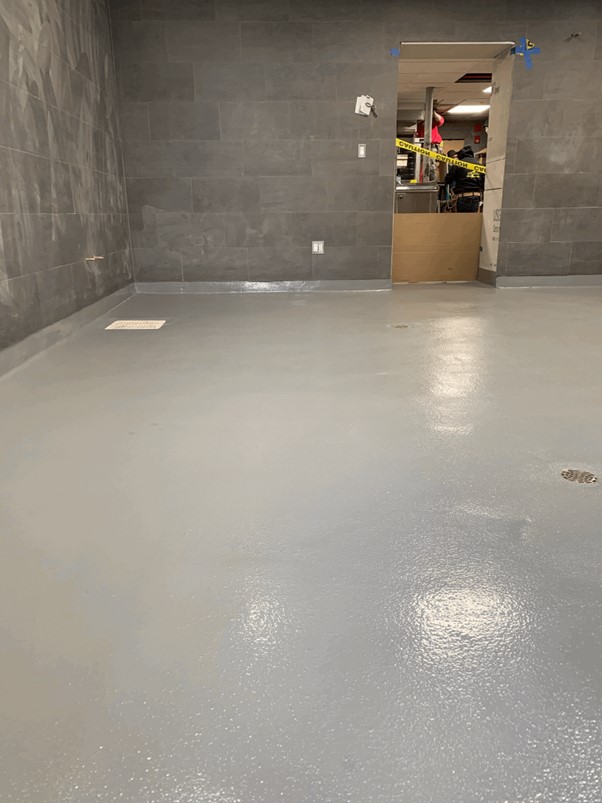
Moisture: Why Hidden Water Ruins Industrial Floors
Moisture is one of the most common reasons industrial floors fail long before the end of their expected service life. Water vapor can rise from the ground, move through the concrete, or remain locked in the slab from the original pour. If nobody measures actual moisture levels before installing the flooring system, the surface may look fine at first, but underlying problems often show up months later.
Typical warning signs that moisture is at work from the inside include:
- Blisters or bubbles forming in the coating.
- Areas where the top layer separates from the base concrete.
- Cracks developing in high‑stress zones.
- Accelerated damage beneath heavy equipment or rack legs.
Even a relatively small failure area in a large facility can be expensive to fix. In many cases, crews have to strip the system back down to bare concrete, re‑prepare the substrate, address the moisture issue, and only then install a new floor. That means direct repair cost plus lost productivity while the area is out of service.
That is why selecting an industrial floor is not only about equipment weight, traffic patterns, and chemical exposure. The actual moisture condition of the slab has to be part of the decision. Proper testing and, when necessary, a dedicated moisture mitigation layer give the flooring system a real chance to reach its full service life instead of breaking down after just a few seasons, even if the product itself is marketed as “premium.”
Main Warehouse Flooring Options
The best warehouse floor is not a single “universal” system, but the one that fits how your facility actually runs. Load levels, type of traffic, exposure to liquids, and acceptable maintenance all play a role. Below are the main solutions we work with in industrial spaces and how they behave over time.
Polished Concrete
In our experience, polished concrete is often the most stable long‑term platform for many warehouses.
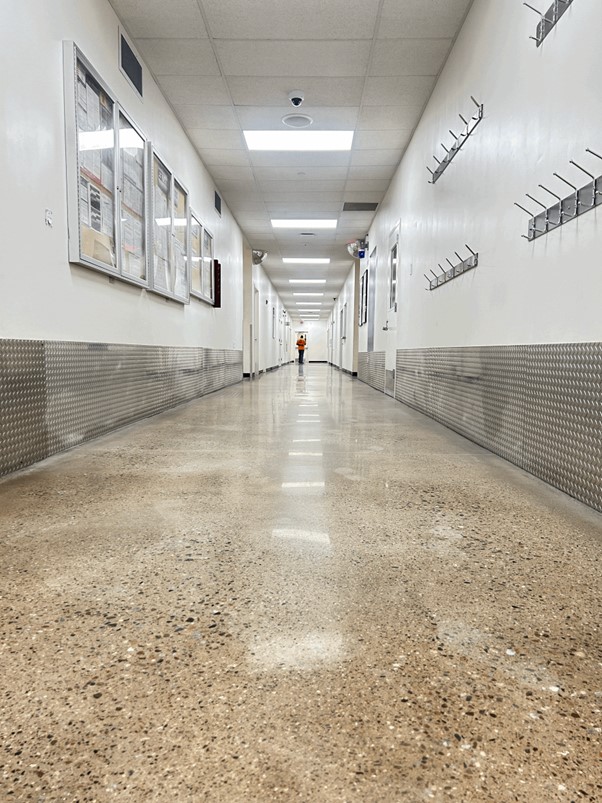
Instead of adding a new layer over the slab, this method turns the existing concrete into the finished surface by grinding, densifying, and polishing it. The result is a hardened, uniform floor with no separate coating that can peel or lift away.
Because there is no traditional “film” on top, many common failure modes simply do not apply: there is no adhesive layer to break, and moisture pressures from below have far less to attack. This makes polished concrete a predictable choice wherever mechanical wear is the primary concern.
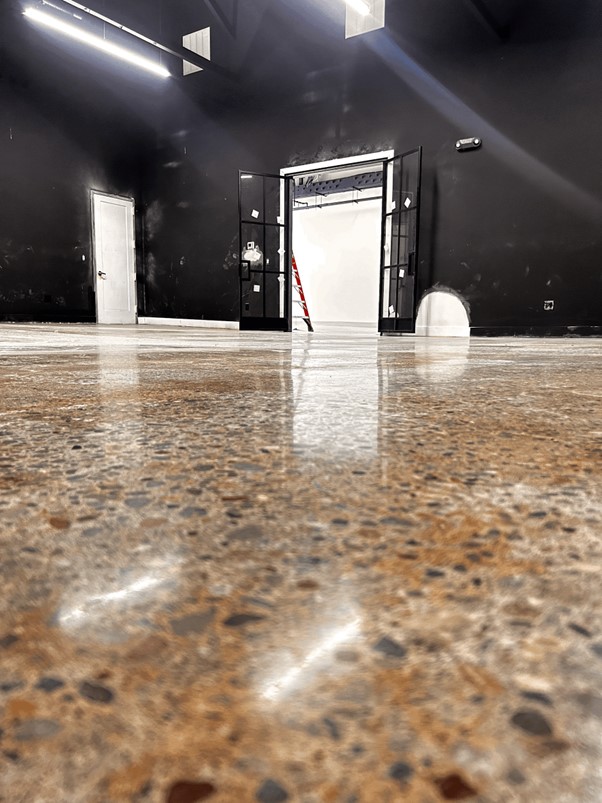
Key advantages:
- Handles constant forklift traffic and loaded pallets without a soft topcoat.
- No coating line between slab and surface that can debond.
- Reduced dust generation and easier daily cleaning.
- Reliable performance under rolling and turning loads.
- Lower lifetime maintenance compared to many film‑forming systems.
- Naturally slip‑resistant when dry (like any concrete, it becomes more slippery when wet, so safety planning is still required).
With proper surface preparation, grinding sequence, and densifier use, polished concrete can deliver very high abrasion resistance in main traffic aisles and staging zones.
However, it is not ideal where floors are regularly wet or exposed to aggressive liquids.
Limitations:
- Limited chemical protection — oils and acids can still penetrate the concrete.
- Slip resistance must be actively managed in wet or contaminated areas.
- Not the best fit for facilities with frequent standing water or process liquids.
Grind and Seal (For Moisture-Sensitive Environments)
When you want to keep a concrete‑based floor but add extra protection, Grind and Seal is often a practical middle ground. The slab is mechanically ground to remove weak material and open the surface, then sealed with a protective topcoat. Unlike high‑gloss polished concrete, this approach focuses on shielding the surface rather than maximizing shine.
Grind and Seal works well where you need more defense against moisture and chemicals than bare or polished concrete can provide, but a full multi‑layer system is not required.
Benefits:
- Better resistance to moisture transmission compared to untreated concrete.
- Surface texture can be adjusted for improved traction.
- Enhanced chemical protection relative to standard polished concrete.
- Balanced cost for facilities that need more than “bare slab,” but not the most complex system.
Epoxy Flooring Systems
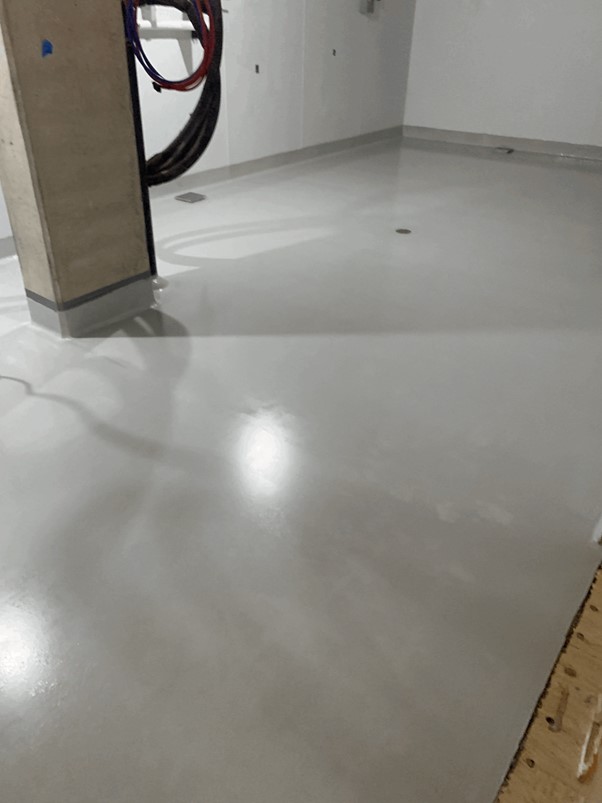
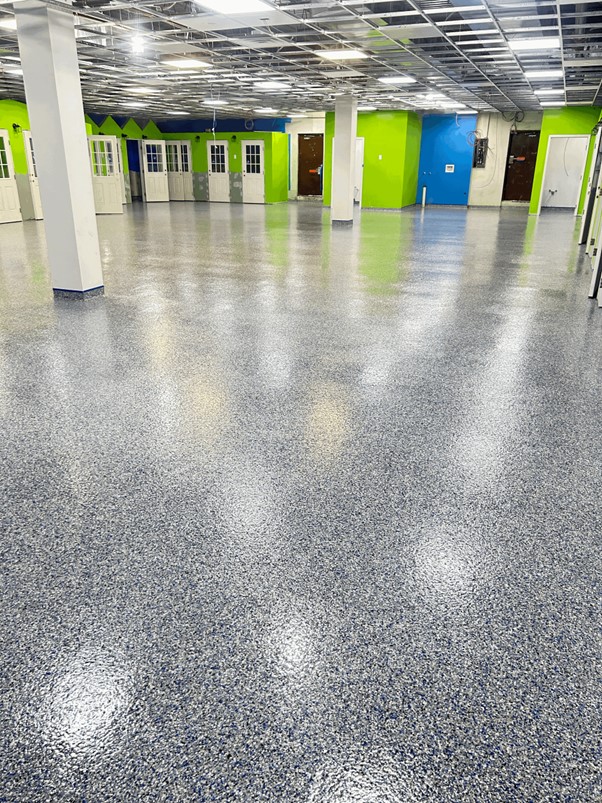
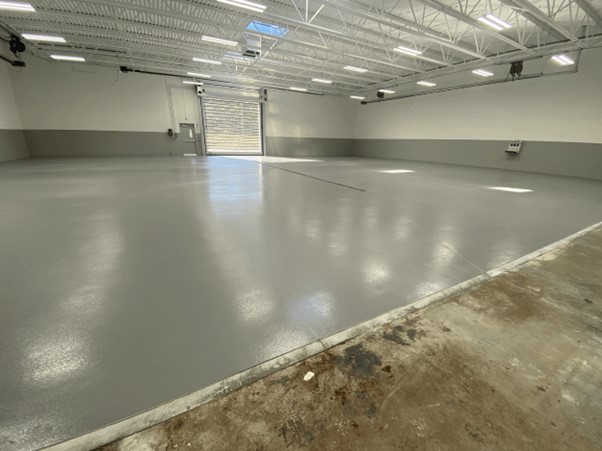
Epoxy flooring is a multi‑layer approach that can be tailored to different parts of a warehouse.
A typical build‑up includes:
- Primer to promote adhesion and, in some designs, serve as a moisture vapor barrier.
- Basecoat that carries the bulk of the load and provides chemical resistance.
- Topcoat or broadcast layer that adds durability, slip resistance, and ease of cleaning.
Depending on the application, systems may incorporate flake broadcast systems for extra thickness and impact resistance, clear topcoats for a seamless look, or Broadcast Sand and other anti‑slip additives in the wear layer.
Strengths:
- Engineered to carry heavy loads and constant forklift traffic.
- Shields the concrete from oils, fuels, chemicals, and moisture.
- Surface texture and slip resistance can be tuned to the space.
- Large continuous areas are easier to clean and keep dust‑free.
- Thickness, finish, and build‑up can be customized by zone.
Considerations:
- Requires thorough substrate preparation, including crack repair and leveling.
- Needs cure time before the floor can be returned to full service.
- Higher initial installation cost than simply leaving the slab exposed.
- Most repairs should be done by trained installers to maintain performance and appearance.
Urethane Cement Flooring
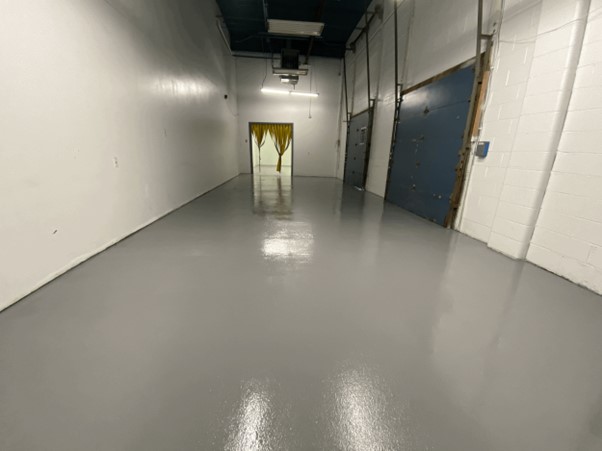
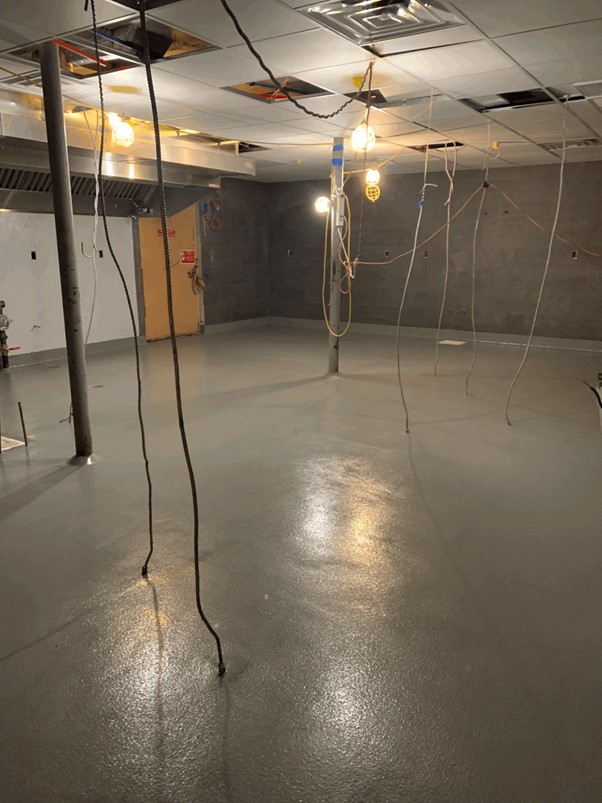
Urethane cement systems are designed for the most demanding conditions.
They combine a cementitious base with polyurethane chemistry to create a thick, highly robust surface that tolerates extreme use.
Typical characteristics:
- High load‑bearing capacity for heavy racks and equipment.
- Outstanding resistance to chemicals, impact, and thermal shock.
- Well‑suited to areas with moisture, wash‑downs, or temperature swings.
- Long service life with relatively modest routine maintenance.
Points to keep in mind:
- Materials and installation are more expensive than many other systems.
- Application should be handled by experienced crews familiar with urethane cement.
- Repairs are usually localized but must be done with compatible materials and techniques.
Concrete Sealers and Light Coatings
Concrete sealers and thin coatings provide a basic level of protection and are often used where loads are lighter and budgets are tighter.
Benefits:
- Lower upfront cost compared to thicker systems.
- Fast installation and minimal downtime.
- Improved dust control and some defense against staining and light wear.
Limitations:
- Limited abrasion and chemical resistance under heavy traffic.
- Not intended for sustained forklift loads or intense point pressure.
- Shorter life cycle than multi‑layer epoxy or urethane cement solutions.
Cold Storage Warehouse Flooring: Building Floors That Survive Freezer Conditions
Installing warehouse flooring in freezers and cold rooms is very different from working in a standard ambient‑temperature facility. Concrete and coatings behave another way when the slab is cold, the air is dry, and heavy equipment moves over the same frozen surface every day. Systems like Epoxy Broadcast Sand Flooring and Urethane Cement can perform extremely well here, but only if the installation and curing conditions are carefully controlled.
Key Considerations for Cold Storage Flooring
- Proper installation temperature: All flooring materials are formulated to cure within a certain temperature range. For most warehouse systems, both slab and air should be above 50°F (10°C) during installation and cure. If coatings are applied to a cold substrate, the film may not form correctly, which can lead to poor adhesion, weaker chemical resistance, and early surface wear.
- Controlled curing time: Freezers and coolers cannot simply stay cold if you want a long‑lasting floor. Units should be shut down or brought up to a suitable temperature during the installation and curing process. If the surface is exposed to freezing conditions too early, you may see bubbling, cracking, or delamination of the system instead of a solid, continuous finish.
- Moisture management: Cold environments often suffer from condensation on floors and walls, especially during door openings or defrost cycles. If this moisture is not controlled, it can interfere with adhesion, create slick areas, and feed long‑term damage. A moisture‑tolerant vapor barrier or a moisture‑resistant flooring system becomes critical to protect the slab and maintain a hygienic, easy‑to‑clean surface.
- Traffic and load considerations: Even inside freezers, the floor must handle pallet jacks, forklifts, and heavy storage racks. Point loads, dynamic forces from braking, and tight turning paths do not disappear just because the temperature is low. Thickness, reinforcement, and final texture should be selected with real traffic patterns and equipment in mind.
When installation temperatures are controlled, moisture is addressed, and the system is matched to actual loads, cold storage floors can remain durable, safe, and easy to maintain for many years.
Distribution Centers Flooring Recommendations
Distribution centers (DCs) have unique flooring requirements compared to standard warehouses. In logistics and distribution areas, floors often see constant heavy traffic. The high volume of pallet movement, constant forklift traffic, and concentrated point loads from heavy racks create extreme stress on concrete slabs. Additionally, chemical spills from oils, fuels, and cleaning agents, combined with the need to minimize downtime, make proper flooring selection critical.
Recommended Flooring Solutions for Distribution Centers:
- Epoxy Flooring with Broadcast Flake or Anti-Slip Topcoat – Provides strong resistance to heavy loads and abrasion, while improving slip safety in high-traffic zones.
- Urethane Cement Systems – Ideal for areas exposed to extreme point loads, frequent chemical spills, or zones requiring maximum durability.
- Moisture Vapor Barrier – Essential for slabs prone to high moisture to prevent bubbling, delamination, and long-term damage.
- Using different systems by zone – Not every square foot of a distribution center needs the same level of protection. Light storage or office‑adjacent areas can often use polished concrete or sealed concrete, while main travel lanes, loading bays, and transfer zones benefit from thicker epoxy or urethane cement systems. This zoning approach allows investment where it matters most and avoids overspending in low‑stress areas.
How to Choose Industrial Flooring for Your Specific Needs
Picking the right warehouse floor comes down to how your facility really operates day to day. What equipment rolls over it, what gets stored, how much liquid hits the surface, and how much downtime you can tolerate — these factors determine if the floor becomes a reliable work platform or a constant headache.
Polished concrete handles standard storage areas with moderate traffic exceptionally well. It creates a hard surface that resists pallets and forklifts while keeping dust low and maintenance simple for years. But when demands ramp up — heavier rack loads, tight forklift turns, chemical spills, or freezer conditions — a basic polished slab falls short, and multi-layer systems step in as the smarter long-term play.
Below are practical recommendations based on real-world performance.
Heavy Loads and Frequent Forklift Turns
Epoxy with broadcast reinforcement or urethane cement overlays.
These work best where:
- Loaded forklifts pound main aisles around the clock.
- Tall racks concentrate weight on small footprints.
- Narrow paths see constant braking, acceleration, and sharp maneuvers.
They deliver:
- Defense against point loads and dynamic impacts.
- Resistance to tire wear from repeated routes.
- Customizable texture for safe equipment and foot traffic.
- Built-in moisture barriers when slabs are damp underneath.
Avoid relying solely on polished concrete where forklifts execute tight turns or use aggressive tires — surface breakdown accelerates fast in those spots.
Chemical-Heavy Environments
For regular contact with oils, fuels, cleaners, or process fluids, the surface needs to block penetration instead of absorbing it.
Go-to choices: Multi-layer epoxy or urethane cement toppings.
Benefits include:
- Full barrier against spills soaking into the base.
- Tolerance for daily cleaning without degradation.
- Anti-slip options for wet or slick conditions.
Basic sealers or untreated polished surfaces hold up initially but let contaminants migrate over time in spill zones. The eventual slab damage costs more to fix than proper protection upfront.
Moisture-Challenged Warehouse Areas
Slabs over wet ground, older pours without vapor barriers, or zones prone to washdowns face “failure from below” risks.
Before deciding:
- Test actual moisture levels in the concrete — visual checks miss the real story.
- Map out freezers, cleaning stations, or standing water spots.
- Plan for a dedicated moisture layer if readings exceed safe limits.
Proven approaches:
- Install a moisture vapor barrier for high-moisture slabs.
- Choose epoxy or urethane cement systems for reliable protection
- Use sealers only in light-duty areas with minimal exposure
When Slip Resistance Is a Priority
Safety drives productivity and cuts insurance headaches. Slick floors in docks, aisles, or spill areas disrupt more than surface cracks ever could.
Recommended options:
- Epoxy systems with anti-slip additives or broadcast flake
- Urethane cement with quartz aggregate
- Polished concrete combined with textured zones or protective topcoats
For Low Maintenance and Easy Cleaning
Seamless surfaces reduce dust accumulation and make it easier to manage oils or chemical residues.
Strong choices include:
- Smooth epoxy flooring
- Polished concrete with protective sealer
- Thick urethane cement in heavy-duty areas
When Budget Is a Key Factor
Cost must be evaluated in terms of long-term performance, not just installation price.
Layered strategy:
- Low-demand storage: polished concrete or penetrating sealers.
- Everyday traffic: mid-duty reinforced surfaces.
- Mission-critical high-load paths: epoxy or urethane cement from day one.
Spending more upfront in brutal zones often beats repeated repairs and shutdowns down the line.
Slab Prep Mistakes That Kill Warehouse Floors (And How to Avoid Them)
No matter how strong the coating — epoxy, urethane cement, or anything else — it only lasts as long as the concrete underneath can support it. Poor slab prep accounts for most early failures, from bubbling coatings to outright cracking. The foundation work sets the entire floor’s service life, so cutting corners here almost always backfires later.
Start with Concrete Slab Assessment
Before any coating touches the surface, evaluate the slab thoroughly across these areas:
- Cracks, spalling, dusting — Walk the floor and mark every visible defect. Small surface issues grow into bigger problems under traffic.
- Flatness check — Use a straightedge or laser level. Deviations over 3 mm in 2 meters create uneven racking, trip hazards, and accelerated wear in forklift paths.
- Compressive strength — Test core samples or rebound hammer readings. Weak spots cannot carry rack loads or repeated equipment impacts.
- Moisture content — Calcium chloride or relative humidity probes give the real numbers. High readings demand vapor barriers; guessing leads to delamination.
Skip any of these checks, and even premium systems underperform within the first year.
Surface Repair and Prep Stages
Turning raw concrete into a flooring-ready substrate takes several deliberate steps. The exact sequence depends on slab age, defects, and end use, but rarely skips these:
- Crack filling and leveling — Inject epoxy or polyurea into fissures, then grind down high spots. Stable surfaces prevent “punching” failures under point loads.
- Profile creation — Shot-blasting or diamond grinding opens the surface for mechanical bond. Too smooth = no grip; too rough = uneven coating thickness.
- Moisture mitigation — Apply vapor suppressors to damp slabs. This step alone rescues many installations that would otherwise fail from below.
- Final cleaning — Degrease with solvent or alkaline cleaners, then vacuum completely. Contaminants cause 90% of adhesion failures.
- Load zone reinforcement — Fiber patches or overlays under rack bases and turn paths add local strength where stresses concentrate.
One overlooked detail — unremoved oil stain, unfilled hairline crack, excess moisture — often triggers failure 6–12 months after load‑in.
Moisture: The Silent Slab Killer
Measure Moisture Vapor Emission Rate (MVER) with calcium chloride kits or in-situ probes — surface moisture meters lie.
Key practices:
- Install vapor barriers on slabs showing >3–5 lbs/1000 sq ft/24 hrs (or RH >75–80%).
- Double‑check older pours, slabs on-grade near water tables, or under cold storage.
- Prioritize protection in washdown areas, freezers, and high‑condensation zones.
A quality barrier stops blisters, lifting, and bubbling before they start, saving removal costs and shutdown time.
Planning Around Equipment and Traffic
Prep extends beyond grinding:
- Mark forklift paths — Main lanes, intersections, turn radii get priority reinforcement.
- Rack pressure zones — Harden concrete under uprights and beams where loads concentrate.
- Safety layout — Plan striping for foot traffic, equipment routes, staging areas.
- Expansion buffer — Account for future re-racking or layout shifts.
Solid prep + traffic foresight = floors wearing evenly for a decade. Half-measures = patch jobs every 2–3 years.
Why Warehouse Flooring Prices Vary So Much
Many warehouse owners run into the same problem: they get wildly different quotes for what sounds like the same floor and struggle to plan a realistic budget. The gap appears because you are never paying only for “epoxy” or “polished concrete” — you are paying for how that system performs on your slab, under your loads, with your downtime limits. A light storage building and a hard‑running distribution center may both need new floors, but the technical solutions — and costs — are not even close. That is why serious budgeting always starts with a proper concrete slab assessment, not just a material price sheet.
1. Type of Flooring System
Each flooring system sits in its own performance and cost band. Cheaper options often look attractive on paper, but if they wear out early or cause operational issues, the total bill over five to ten years can end up higher than a stronger system installed once.
Concrete Sealers
These are the entry‑level option. They work in light‑duty storage, offices, and areas without forklifts or frequent spills. Sealers help with dust control and basic protection but offer limited chemical and abrasion resistance, so they are not intended for heavy equipment or high‑traffic aisles.
Polished Concrete
Usually lands in the mid‑range because of the multi‑step grinding and polishing sequence. Final price depends on how refined the surface should be — from a simple industrial finish to a higher‑gloss look — plus the condition of the slab and the amount of densifier and repair work needed. Done right, it offers a long‑lasting, low‑maintenance surface for many warehouses.
Epoxy Flooring Systems
Also typically a mid‑range investment, but with more flexibility. Epoxy can be built up with broadcast flake, quartz, non‑slip additives, and moisture barriers to handle heavy traffic, frequent turning, and chemical exposure. It is a strong fit for busy aisles, loading docks, and process areas where the floor takes daily punishment.
Urethane Cement
This sits at the upper end of initial cost but is designed for the harshest environments: high impact, aggressive chemicals, temperature swings, and constant moisture. In spaces where a failed floor would shut down production or compromise safety, the extra upfront spend is often justified by long service life and fewer unplanned repairs.
2. Concrete Slab Preparation
Slab prep is the line item many budgets underestimate — and the one that most often determines whether a floor lasts or fails early. The more issues the concrete has, the more work it takes to get it ready.
- Crack repair and leveling
Badly cracked or uneven slabs require more resin, patching material, and labor. Ignoring these defects just shifts the cost into future repairs.
- Moisture vapor barriers
If moisture readings are high, a vapor barrier becomes non‑negotiable. It adds to upfront cost but prevents blisters, bubbles, and delamination that would otherwise show up a year or two later.
- Grinding or shot‑blasting
Creating the correct surface profile is essential for adhesion. Stronger or thicker systems often need more aggressive prep, which adds machine time and labor but directly supports long‑term performance.
Investing in solid prep usually extends the life of the entire system and cuts what you spend on fixes and downtime over the years.
3. Facility Size and Functional Zones
Total square footage matters, but not in a simple “bigger is more expensive” way. Larger jobs sometimes benefit from economies of scale, lowering the cost per square foot. At the same time, not every part of the warehouse needs the same level of protection.
A zoning strategy helps balance cost and performance:
- High‑load areas and forklift turning zones get reinforced systems with greater thickness and durability.
- Light storage and low‑traffic areas can run on simpler, more economical solutions.
- Chemical handling or washdown zones are designed with higher chemical and moisture resistance.
Cutting corners in the most stressed areas usually shows up as accelerated wear, safety issues, and an early need for partial replacement.
| System |
Heavy Loads |
Chemical Resistance |
Moisture Tolerance |
Cost Level |
Best For |
| Polished Concrete |
Medium |
Low |
Medium |
$$ |
Dry storage, moderate traffic |
| Grind & Seal |
Medium |
Medium |
Good |
$$ |
Moisture areas, light chemicals |
| Epoxy (flake/sand) |
High |
High |
Good* |
$$$ |
High traffic, chemicals |
| Urethane Cement |
Very High |
Very High |
Excellent |
$$$$ |
Cold storage, harsh conditions |
| Sealers |
Low |
Low |
Poor |
$ |
Office/light storage |
Understanding the Real Installation Cost
There is no single “correct” price that fits every facility, even if the square footage is similar. Warehouse flooring cost is not just a material number per square foot — it is a package that includes:
- System capabilities (load handling, chemical and abrasion resistance, slip safety).
- Concrete preparation: crack repair, leveling, cleaning, moisture control.
- Total area and how it breaks down by zone type.
- Optional upgrades such as decorative flake, non‑slip texture, or vapor barriers.
- Downtime during installation and cure, including any phased work to keep operations running.
- Long‑term maintenance: how often you will need repairs, touch‑ups, or deep cleaning.
When you look at all these factors together, the “cheapest” option on day one is often not the least expensive over the life of the floor.
How Flooring Choices Support Safety and Compliance
The floor you choose shapes how safely your warehouse runs every day. Different systems make it easier or harder to meet OSHA requirements, reduce accidents, and pass inspections.
Built‑In Slip Resistance by Design
Epoxy and urethane cement systems integrate grit, flakes, or texture directly into the coating, creating consistent grip even when surfaces are damp from spills or cleaning. Polished concrete works well in dry areas but may need targeted anti‑slip zones at docks or intersections. The result: confident forklift handling and fewer employee slips, which directly cuts injury claims and insurance premiums.
Seamless Floor Striping and Zoning
Resin floors accept durable paint or embedded color lines that withstand forklift traffic for years. Mark forklift paths in yellow, walkways in white, and staging in green to create clear visual separation. This simple step reduces collisions, speeds up training for new hires, and helps during OSHA walkthroughs.
Better Visibility, Fewer Accidents
Light‑colored or reflective finishes bounce more light around the space, cutting shadows and making pallets, spills, and obstacles easier to spot. Operators drive safer, pickers move faster, and inspectors see what they need to. A small design choice that pays off in smoother operations and lower accident rates.
Putting It All Together: Your Warehouse Flooring Decision
The best warehouse flooring solution is not the most expensive one on paper — it is the system that matches your actual loads, traffic, moisture, and chemical exposure. When the slab is properly evaluated and prepared, polished concrete, epoxy, and urethane cement can all deliver long service life with predictable maintenance. For Pennsylvania facilities, it is especially important to account for seasonal moisture changes, cold storage areas, and high‑traffic distribution zones during design. A floor chosen this way protects your concrete, supports safe movement of people and equipment, and keeps your operation running without avoidable interruptions.
Get a Realistic Warehouse Flooring Cost Estimate
Warehouse floors carry more than pallets — they support your entire operation. The right system reduces repairs, keeps people safe, and lets equipment run smoothly without constant interruptions. If you are planning a new installation or replacing an existing floor, we can help you:
- Evaluate slab condition and moisture levels
- Identify risk zones (forklift traffic, chemical exposure, heavy racks)
- Recommend the most suitable flooring system for your operations
- Provide a clear and detailed installation estimate
- Delivering professional installation with full safety and traffic planning
Get your slab evaluated by someone who understands industrial conditions. Our goal is not just to install a floor — but to deliver a system that supports safe operations, protects your concrete slab, and minimizes downtime.
Contact us for a consultation and project evaluation. We will meet you on-site, assess your facility, and deliver a flooring solution that is durable, safe, and built for long-term performance.
Frequently Asked Questions (FAQs)
With the right design and preparation, modern warehouse flooring systems can perform for a decade or more. Epoxy and urethane cement floors commonly deliver 10–20 years of service under normal warehouse conditions, while polished concrete can match that lifespan when chemical exposure and moisture are under control. Poor slab preparation or an undersized system usually shortens this period dramatically, leading to early cracking, delamination, and repairs.
Yes, if designed for it. Epoxy and urethane cement create effective barriers against oils, fuels, and cleaners. Polished concrete and basic sealers offer limited protection and may absorb liquids over time.
Use anti-slip additives, textured broadcast flake, or matte coatings in high-traffic areas and forklift paths. Implement line striping for pedestrian and equipment zones, and ensure light-reflective finishes to enhance visibility and reduce accidents.
Yes. Depending on load requirements and warehouse zones, you can combine systems. For example, use Epoxy or Urethane Cement in high-traffic or heavy-load areas, Polished Concrete for moderate traffic, and Concrete Sealers in light-storage or administrative zones. This approach optimizes durability, safety, and cost across the warehouse.
Yes. All major systems — Epoxy, Urethane Cement, and Polished Concrete — can be used. The critical factor is temperature control: installation and curing must occur above 50°F (10°C), so freezer units need to be off or carefully regulated during this period.
The right system depends on how your warehouse actually operates. Key factors include equipment weight, forklift traffic patterns, rack layout, chemical exposure, moisture levels in the slab, and any cold storage zones. Polished concrete often works well for dry storage with moderate traffic, while epoxy and urethane cement are better suited to heavy loads, frequent forklift turns, or aggressive liquids. A site visit and moisture testing provide the data needed to match a specific flooring system to your facility instead of relying on a one‑size‑fits‑all approach.
Cost depends on flooring type, slab preparation, moisture control, area size, additional features (anti-slip, broadcast flake), and future maintenance needs. Skipping proper prep can increase repair costs later.
Typically 24–72 hours before light use, and up to 7 days for full load capacity. Curing time depends on temperature, humidity, and coating thickness.
Yes. Large warehouses can be installed in zones according to traffic, load, and chemical exposure, allowing operations to continue during installation.
Cracks widening, coating bubbling or lifting, heavy dusting, chemical stains penetrating, or slick/uneven surfaces causing equipment issues. Early action prevents bigger downtime.
Yes. Anti-slip additives, broadcast flake, and proper surface finish reduce slips and falls, even in high-traffic corridors and chemical zones.
Yes, when designed with proper slip resistance, clear markings, and maintained flatness. Anti‑slip additives, color‑coded lines, and reflective surfaces help pass inspections and reduce accidents.
Yes. Call, email, or use the form. We will walk your facility, assess the slab and traffic, recommend the best system, and provide pricing that fits your operation and timeline.





